
Public Art as Action Research
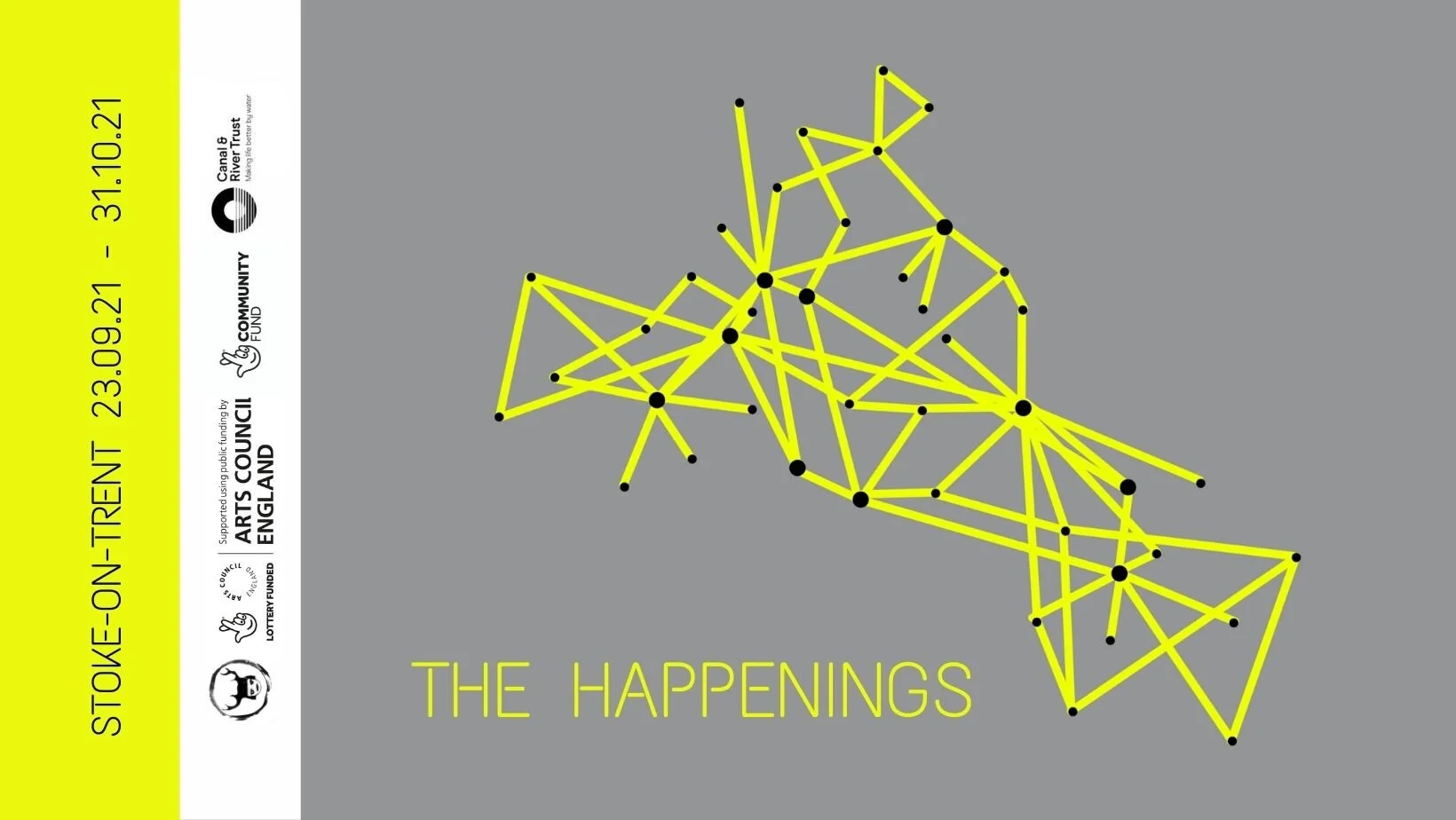
The Happenings was a festival of public art produced by Urban Wilderness CIC in Stoke-on-Trent (Sept-Oct 2021) conceived as a continuation of the ideas explored in Public Art Now! Symposium (April 2021). While the symposium raised questions about participation, power, and the role of public art, The Happenings responded through action research, activating those questions directly in the city’s streets, parks, canal edges, alleyways, and empty shop units.
The festival explored core questions: What might public art look like now? Who is it for? and How can it re-activate overlooked urban places through creativity, care, and connection? Designed as a series of hyper-local artistic interventions, the programme prioritised small-scale, human-centred works, inviting curiosity, participation, and repeated encounter. It re-imagined the energy of 1990s DIY rave culture — transforming overlooked spaces — but for a time of pandemic recovery, social reflection, and relational experimentation.
Embedded and Contextual Practice
Interventions were most effective when embedded in the social and cultural fabric of their locations. In Longton Exchange, a town centre square historically impacted by anti-social behaviour, artworks created opportunities for engagement with local life. People responded positively to the use of empty shops as exhibition spaces, appreciating installations that were accessible, thought-provoking, and culturally resonant. Signage and on-the-ground communication proved important for encouraging participation and discovery.
At Burslem Port, a former brownfield site by the canal, installations encouraged curiosity and interaction in unexpected ways. Some artworks were carefully handled or explored by passers-by, demonstrating a physical and creative relationship between the public and the art. Placement and visibility were crucial, particularly in areas less frequented by the public.
Across sites, interventions highlighted a public appetite for artistic activity that feels relevant, temporary, and participatory, showing how small-scale, site-specific works can transform overlooked urban spaces.
Artists’ Experience and Growth
The festival offered a developmental and transformative experience for participating artists. With support from Urban Wilderness as facilitators and producers, artists were able to experiment with new materials, respond to site-specific contexts, and explore new modes of practice. Many reflected on the freedom to treat research, experimentation, and public engagement as part of their creative process.
Artists also valued the opportunity to engage with diverse communities, fostering dialogue and collaboration while gaining skills, confidence, and professional networks. The process of co-creation, though experienced differently by each artist, was enabling and relationship-driven, linking creative practice directly to the people and spaces of Stoke-on-Trent.
Learning from the Festival
The Happenings demonstrated that small-scale, site-specific interventions can:
Activate overlooked or dormant urban spaces in ways that are inclusive and locally meaningful.
Encourage public curiosity, dialogue, and repeated engagement without relying solely on online promotion.
Support artist experimentation and professional growth, creating skills, confidence, and networks.
Transform everyday urban experiences into moments of reflection, encounter, and possibility.
By embracing the temporary, the unexpected, and the site-specific, The Happenings challenged conventional models of public art. It showed how public art can be research, experimentation, and community-building, shaping the city through creativity, care, and connection.
